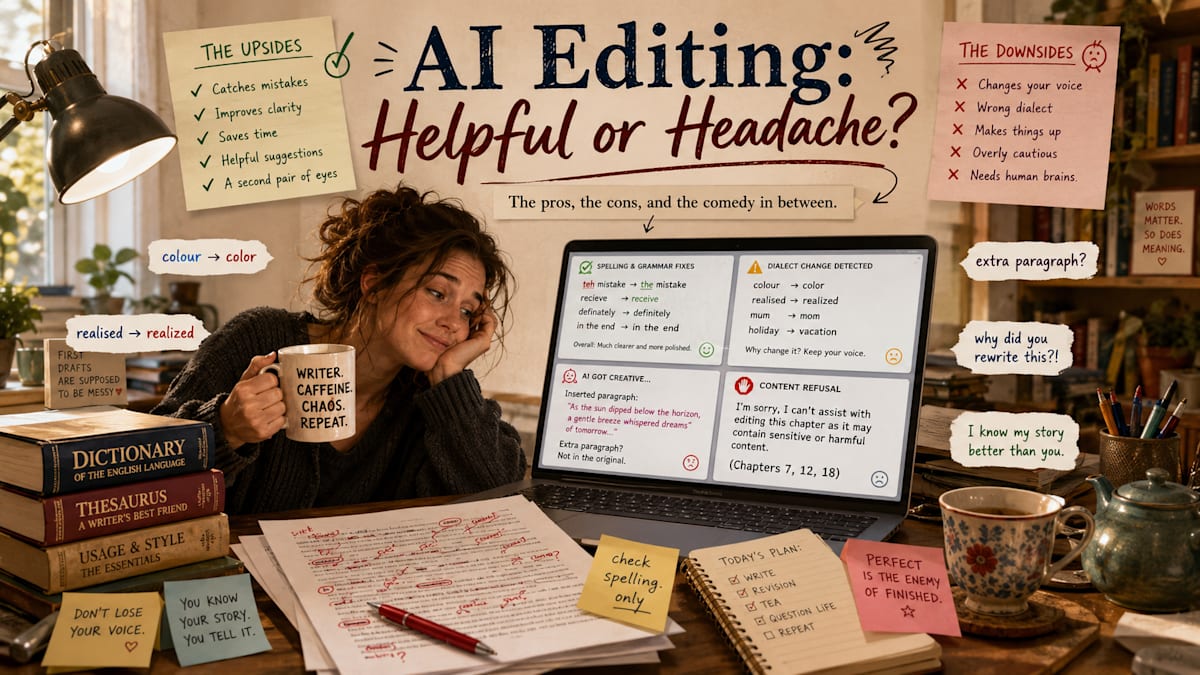
AI editing tools can be an absolute lifesaver when writing books. They can also make you want to launch your laptop into the nearest body of water. As someone who is terrible at spelling, I genuinely do appreciate having something there to catch the obvious mistakes. The missing commas. The words that are nearly right but not quite. The repeated phrases that somehow slipped through because, after reading the same chapter seventeen times, my brain has decided it knows what the sentence *should* say rather than what it actually says. When AI is good, it is brilliant. It can tidy up messy sentences, spot spelling errors, smooth out grammar, and help make a chapter feel more polished. For indie authors especially, where budgets are not always friendly and professional editing can be expensive, AI can feel like having a helpful little assistant sitting beside you going, “Actually, that sentence has gone completely feral.” But there are definitely downsides. One of the biggest issues I have found is that AI has a very annoying habit of switching things into American spelling and grammar. I write in British English. My characters are British. My books are full of British Army banter, British slang, and characters who would absolutely say “arse” instead of “ass.” So when a tool quietly changes “realised” to “realized,” “colour” to “color,” or starts rearranging punctuation and phrasing in a way that feels more American, it can completely pull the voice out of the book. The problem is, when spelling is already not a strong point, those changes are not always obvious. Sometimes I do not spot them until a reader kindly points it out. By then, I am staring at the screen wondering how many more rogue Americanisms have snuck into the manuscript like little grammatical spies. Then there is the hallucination problem. AI does not always just correct what is on the page. Sometimes it gets creative. Too creative. It starts adding things from previous chats that have nothing to do with the current book. Suddenly a character is referencing something from an entirely different story, a plot point appears that never happened, or a sentence pops up that makes absolutely no sense in context. And then there are the mystery paragraphs. You ask for a spelling and grammar check. Just that. Nothing fancy. No rewriting. No “make this better.” No “please add a dramatic monologue about the emotional weight of war.” Just check the spelling and grammar. Then the AI comes back with three extra paragraphs you never asked for, full of information that adds nothing, improves nothing, and occasionally damages the pacing so badly it feels like the chapter has tripped over its own boots. Gemini, in particular, has been the worst for this. It will confidently wander off and start adding whole chunks that nobody requested, nobody needed, and nobody in their right mind would keep. There is also the very specific joy of AI refusing to check the sexy chapters. Apparently, some scenes are too graphic for a spelling and grammar check. Which is both frustrating and, depending on how you look at it, possibly a compliment. There is something deeply ridiculous about sitting there thinking, “I am not asking you to judge the scene, I am asking whether I have spelt ‘desperately’ correctly.” So instead of saving time, I end up doing the strangest kind of editing imaginable: proofreading the proofreader. I check the AI’s corrections. I check whether it has changed British spelling. I check whether it has softened the character voice. I check whether it has added something unhinged from another project. I check whether it has randomly inserted a paragraph that sounds like it escaped from a completely different book. And at some point, usually several hours in, I do find myself wondering whether it would have been quicker to sit there with a dictionary and a thesaurus and do the whole thing myself. That is the strange thing about AI. It can be incredibly useful, but it is not a replacement for the author’s eye. It does not understand your characters the way you do. It does not always respect your voice. It does not always know when to leave a sentence alone. And it definitely cannot be trusted to quietly polish a manuscript without supervision. For me, AI works best as a tool, not a final authority. It can catch mistakes. It can suggest improvements. It can help when my brain has stopped seeing errors because I have been staring at the same paragraph for too long. But every change still needs checking. Every “improvement” needs questioning. Every suspiciously polished sentence needs holding up against the character’s actual voice. Because writing a book is not just about clean grammar. It is about rhythm, tone, personality, mood, and the little imperfect choices that make a story feel alive. AI can help tidy the room. But I still need to make sure it has not redecorated the house while I was not looking.
May 9, 2026
The Pros and Cons of Using AI to Edit Spelling and Grammar When Writing Books