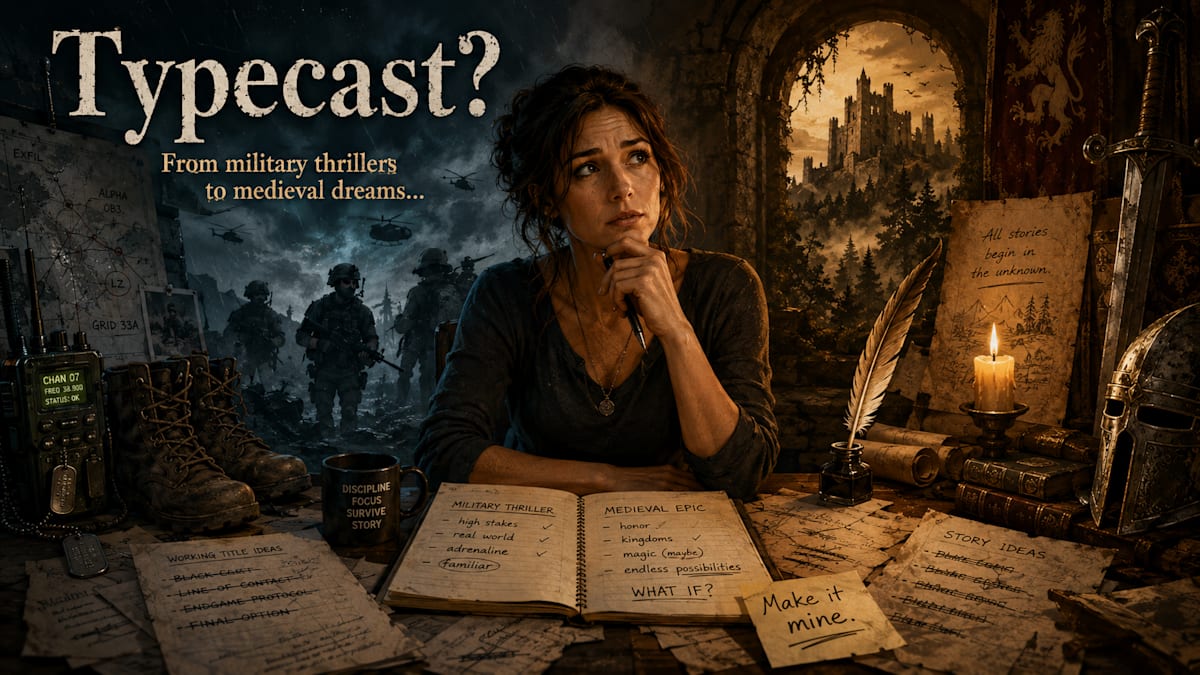
I think I may have accidentally typecast myself.
Not in a bad way. Not in a “someone stage an intervention” way. More in a “oh look, here I am again throwing soldiers into emotionally devastating situations with rifles, trauma, banter, and questionable survival odds” kind of way.
And honestly?
I love it.
Military thrillers, military romance, military horror — they are very much my comfort zone. Which is a slightly concerning sentence when that comfort zone usually involves mud, blood, bad decisions, gallows humour, monsters, warzones, and people trying very hard not to admit they have feelings.
But there is something about that world that keeps pulling me back in. I love the intensity of it. The loyalty. The structure. The way characters are forced to operate under pressure. The way humour becomes a survival mechanism. The way love, friendship, fear, courage, and grief all hit harder when nobody knows if they are making it home.
It gives everything sharper edges.
A romance is never just a romance when the characters are in uniform, carrying trauma, living by rules, and risking everything. A horror story feels even worse when the people facing the monster are trained professionals who should, in theory, know what they are doing. A thriller becomes more tense when every decision has consequences and there is no time to fall apart.
So yes, I love writing military books.
But I also fancy a change.
There is a little voice in my head at the moment whispering, “What about something medieval?”
Which, naturally, immediately sounds exciting and awful in equal measure.
Medieval settings have so much potential. Castles. Mud. Swords. Brutal politics. Dangerous journeys. Ancient forests. Superstition. Monsters in the dark. People making terrible decisions by torchlight. It has all the ingredients I already love: danger, loyalty, violence, romance, survival, and the constant threat of someone being stabbed dramatically in a courtyard.
So really, it makes sense.
Except then comes the giant creative elephant in the room.
How do you write anything medieval and dark without accidentally creating something that feels like a budget version of The Witcher or Game of Thrones?
Because that is the problem, isn’t it?
The second you put a grim warrior on a horse and send him towards a village with a monster problem, everyone thinks of The Witcher. The second there is a castle, a noble family, a throne, a betrayal, or someone brooding in a fur cloak, Game of Thrones starts looming over your shoulder like an unpaid creative consultant.
And I do not want to write “The Witcher, but worse.”
I definitely do not want to write “Game of Thrones, but with fewer dragons and more panic.”
That is the challenge. Finding the thing that makes it mine.
Because medieval fantasy, like military fiction, is full of familiar ingredients. Swords. Kings. Mercenaries. Witches. Curses. Plagues. Prophecies. Monsters. Betrayals. Battlefields. None of those things are the problem. The trick is in how they are used. The voice. The characters. The emotional core. The atmosphere. The particular flavour of misery I decide to inflict on everyone.
Which, let’s be honest, will probably be significant.
I think the way through it is not to try to avoid every comparison. That is impossible. Every genre has shadows. Every story sits near something else. Readers make comparisons because it helps them understand the mood and shape of a book.
The real goal is to avoid copying the bones.
No chosen-one prophecy just because fantasy books often have one. No throne war unless there is a genuinely fresh reason to care. No monster hunter who feels like he has wandered in from someone else’s franchise. No court politics unless I can make them sharp, personal, and horrible in a way that belongs to my world.
Maybe the answer is to lean into what I already do well, but change the setting.
Instead of rifles and radios, swords and signal fires.
Instead of modern soldiers with gallows humour, maybe hardened sellswords, exhausted knights, battlefield medics, prisoners, scouts, or castle guards who have seen too much and still have to keep going.
Instead of military command structures, feudal loyalties.
Instead of NATO patrols, border marches.
Instead of monsters in the mountains with modern weapons failing against them, something ancient crawling out of a forgotten keep while everyone realises steel may not be enough.
That does sound very me, actually.
Maybe I am not trying to escape my usual themes completely. Maybe I am just changing the armour.
Because at the heart of it, I do not think I write “military” purely because of the guns and uniforms. I write it because I like people under pressure. I like loyalty being tested. I like love when it is inconvenient, dangerous, and badly timed. I like characters who use sarcasm because honesty would hurt too much. I like survival stories where the enemy outside is terrifying, but the emotional damage inside the group might be just as dangerous.
All of that can exist in a medieval world.
It just needs to be built carefully.
So yes, maybe I have typecast myself a little. Maybe readers expect soldiers, warzones, monsters, romance, trauma, and somebody making a terrible joke at the worst possible moment.
But maybe that is not a cage.
Maybe it is a signature.
And maybe the next challenge is seeing what happens when that signature gets dragged backwards through time, handed a sword, shoved into a crumbling fortress, and told there is something moving in the woods.
Will I write it?
Possibly.
Will I overthink it?
Absolutely.
Will I spend half the time worrying it sounds too much like The Witcher or Game of Thrones?
Almost definitely.
But the idea is there now, rattling around in my head, wearing chainmail and causing trouble.
So we’ll see.
Maybe it is time to swap bullets for blades.
Just for a little while.